 Save
Save My hands were sticky with honey the first time I truly understood baklava—not from a recipe book, but from watching my neighbor assemble layer after delicate layer in her cramped kitchen one autumn afternoon. She moved with such unhurried grace, brushing butter between phyllo sheets so thin they were practically translucent, that I realized this wasn't just dessert; it was a conversation between patience and precision. Years later, when I finally made my own batch, the kitchen filled with that unmistakable aroma of toasting nuts and caramelizing butter, and suddenly I understood why she smiled while working.
I made this for my book club on a rainy Tuesday, nervous the layers would disappoint, but watching someone close their eyes after that first bite told me everything. The combination of crisp, shattered phyllo, the buttery richness, and that lingering floral note from the honey syrup became the thing people asked about before the wine glasses were even empty. It's one of those desserts that somehow feels both indulgent and light, which shouldn't be possible but absolutely is.
Ingredients
- Phyllo dough (16 oz / 450 g, thawed): This paper-thin pastry is the backbone of baklava, and yes, you must thaw it properly or it becomes brittle and impossible to handle—trust me, I learned this the frustrating way.
- Unsalted butter (1 cup / 225 g, melted): Use real butter here; it's not just fat, it's flavor, and it's what creates those golden, shattering layers that make baklava worth making.
- Shelled pistachios (2 cups / 250 g, finely chopped): The green color matters as much as the taste, so buy the best quality you can afford and chop them by hand if time allows—the texture is superior.
- Granulated sugar for filling (1/2 cup / 100 g): This balances the nuttiness and sweetens the filling without overpowering the delicate pistachio flavor.
- Ground cinnamon (1 tsp): One teaspoon is enough to warm the filling with that familiar spice without making it taste like a dessert from a spice rack.
- Honey (1 cup / 340 g): Use honey you'd actually eat on its own—the quality translates directly into the syrup, and mediocre honey makes mediocre baklava.
- Water (3/4 cup / 180 ml): This dilutes the honey syrup to the perfect consistency so it absorbs into the pastry instead of pooling at the bottom.
- Granulated sugar for syrup (1/2 cup / 100 g): This adds body to the syrup and prevents it from being too runny.
- Lemon juice (1 tbsp): A small but crucial ingredient that cuts through the sweetness and adds brightness the syrup absolutely needs.
- Orange blossom water (1 tsp, optional): If you use this, you'll understand why Middle Eastern desserts taste like nothing else in the world—it's floral, delicate, and transforms everything.
Tired of Takeout? 🥡
Get 10 meals you can make faster than delivery arrives. Seriously.
One email. No spam. Unsubscribe anytime.
Instructions
- Set your stage:
- Preheat your oven to 350°F (175°C) and brush a 9x13-inch baking dish thoroughly with melted butter—this prevents sticking and adds flavor to every corner of the baklava.
- Prepare the nut mixture:
- Combine your finely chopped pistachios, 1/2 cup sugar, and cinnamon in a bowl, stirring until everything is evenly distributed. This is the moment you'll notice how aromatic pistachios become when combined with warm spices.
- Build the bottom layers:
- Lay down 8 sheets of phyllo, brushing each one generously with melted butter as you go—the butter is what transforms papery phyllo into something crisp and golden. Work quickly but without rushing; each layer should be completely coated before you add the next.
- Add the first filling layer:
- Sprinkle exactly 1/3 of your pistachio mixture evenly across the phyllo, distributing it so every bite will have nuts. You want it generous enough to taste but not so thick that the layers separate.
- Continue layering:
- Add 4 more phyllo sheets (brush each with butter), then another 1/3 of the nut mixture, then 4 more sheets with butter, and finally the remaining pistachios. The repetition creates those distinct layers that make baklava satisfying to bite through.
- Top with the final phyllo:
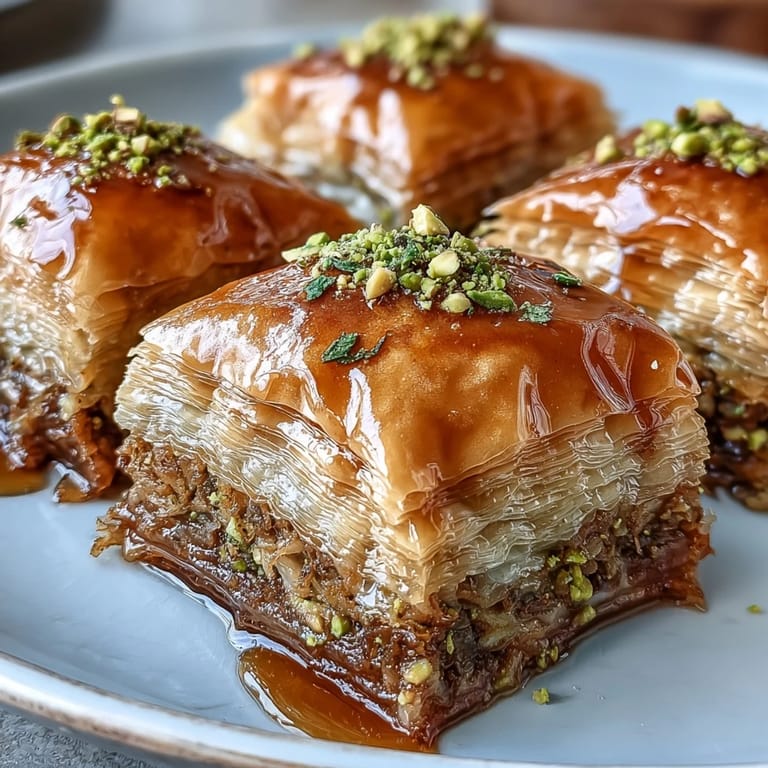
- Finish with 8 sheets of phyllo, each brushed carefully with butter, creating a protective crust that will turn golden and crispy. This top layer is what gives baklava its shattered texture, so don't skip the butter.
- Score before baking:
- Using a sharp knife, cut the entire assembled baklava into diamonds or squares before it bakes—trying to cut it after makes a crumbly mess. Cut all the way through to the bottom so each piece is distinct.
- Bake to golden perfection:
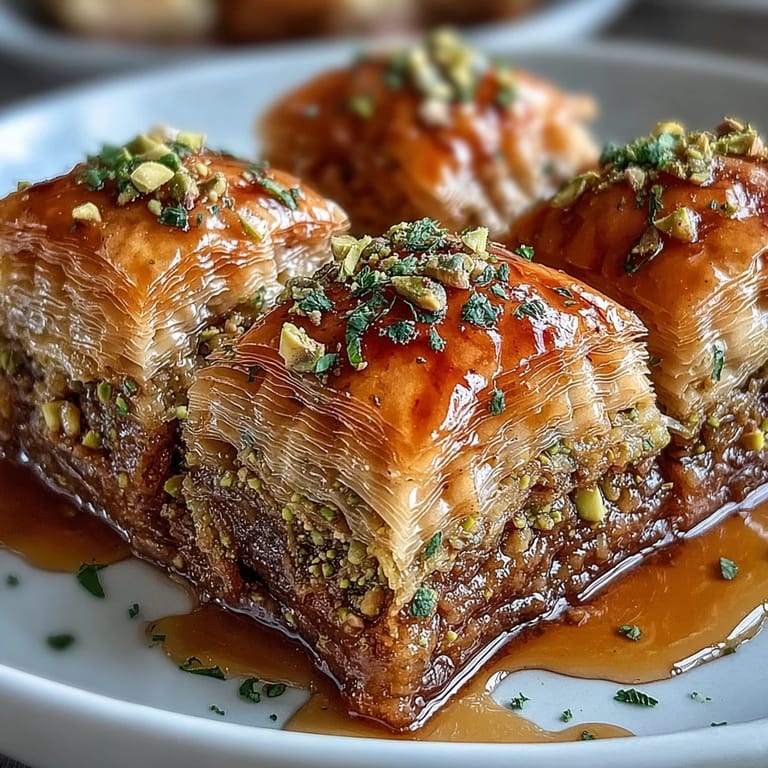
- Bake for 35 to 40 minutes until the top is deep golden brown and you can hear it crackling slightly when you move the pan. The kitchen will smell like butter and toasted nuts in the most incredible way.
- Make the syrup while baking:
- In a saucepan, combine honey, water, 1/2 cup sugar, and lemon juice, bringing it to a boil before reducing heat and simmering for 8 to 10 minutes. Stir in orange blossom water if using, and let it cool slightly—it should be warm but not actively steaming.
- The crucial pour:
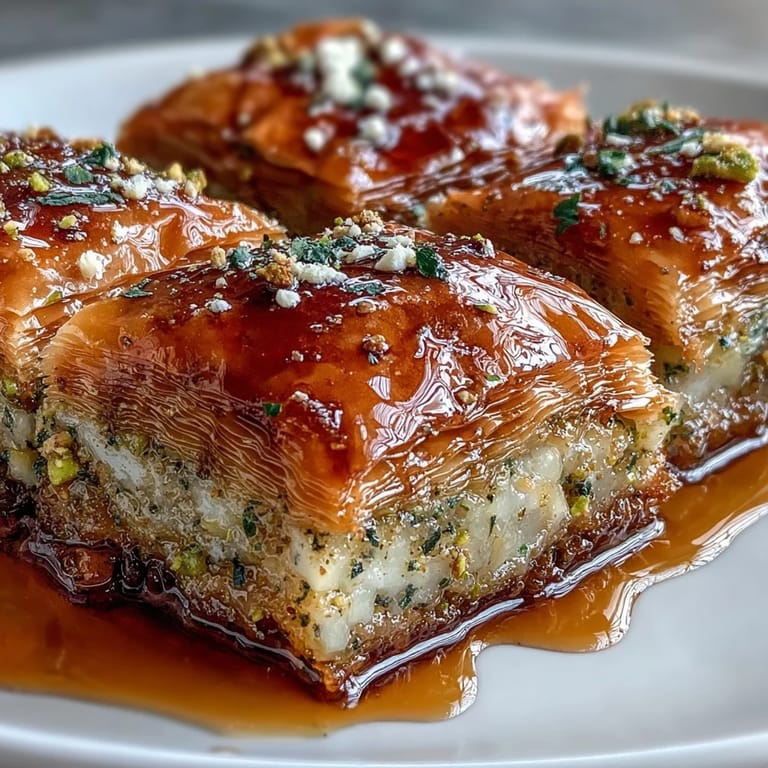
- Remove baklava from the oven and immediately pour the warm syrup evenly over the entire surface, watching it sizzle slightly as it hits the hot pastry. This immediate application is the secret to syrup absorption; wait too long and the baklava won't drink it in properly.
- Cool completely:
- Allow everything to cool at room temperature for at least a couple of hours before serving, which gives the syrup time to soak through all the layers and the baklava to firm up into crispy, manageable pieces.
 Save
Save I remember my daughter asking why baklava tastes different when Grandma makes it, and realizing it's because she treats each layer like it matters—not rushing, not cutting corners on butter, respecting the time and the ritual. That's when baklava becomes more than dessert; it becomes a small act of care offered to people you're feeding.
Why Phyllo Demands Respect
Phyllo is theatrical and a little temperamental, but once you understand it, the relationship becomes almost meditative. It wants to be handled with cool, dry hands, kept covered with a damp towel so it doesn't dry out, and treated like something precious—because it is. The first time I worked with phyllo confidently instead of frantically, I realized I was finally moving like my neighbor did all those years ago, with intention rather than anxiety.
The Syrup Timing Game
This is where baklava either sings or disappoints, and the difference is literally minutes. The syrup needs to meet hot pastry, creating this magical moment where the crispy exterior stays crispy while the interior layers drink in sweetness and flavor—it's physics and instinct combined. I've made baklava when I waited too long to pour, and the result was disappointing in ways I couldn't quite articulate until I got it right and understood what I'd been missing.
Serving and Storage Secrets
Baklava is generous enough to improve over a couple of days as the syrup continues to penetrate the layers, so making it ahead is actually an advantage rather than a compromise. Store it covered at room temperature (yes, room temperature—the refrigerator is baklava's enemy, making it dense and sad), and it will keep beautifully for up to a week if it hasn't disappeared faster than that. The best time to eat it is with strong coffee or mint tea, in good company, without any other distractions.
- Serve at room temperature so you get that contrast between warm, syrupy layers and crispy-edged pieces.
- If you want to get fancy, top individual servings with a few extra pistachios or a tiny pinch of cardamom right before serving.
- Make extra because people will ask for the recipe, and then they'll ask if you'll make it again, and suddenly you're the baklava person in your friend group.
 Save
Save There's something almost sacred about making baklava, the way time slows down when you're building those layers, and the way it tastes like someone really cared about feeding you. Make this for the people who matter most, or make it for yourself on a day when you deserve something extraordinary.
Recipe Questions & Answers
- → What type of nuts are used in this dessert?
Finely chopped pistachios are the primary nuts, but walnuts can also be substituted or mixed in for variation.
- → How is the honey syrup prepared?
The syrup combines honey, water, sugar, lemon juice, and optionally orange blossom water, boiled and simmered to a fragrant finish.
- → What is the best way to layer the phyllo dough?
Brush each phyllo sheet generously with melted butter before layering to ensure crispness and rich flavor.
- → Can this dessert be made ahead of time?
Yes, it can be prepared in advance and stored at room temperature; the flavors deepen over time.
- → Are there common allergens in this dessert?
Yes, it contains tree nuts (pistachios), gluten from phyllo dough, and dairy from butter.